
Introduction
American political debate today often centers on ethical issues. Recent discussions have touched on topics such as police use of force, systemic racial disparities, gender identity, and instances of abuse within the church. This polarized climate sometimes makes it challenging for Christians to evaluate social issues through a consistently biblical framework.
This is where Herman Bavinck’s work becomes especially relevant. Despite the many changes in technology and society since his time, Bavinck grappled with enduring questions that continue to drive modern discourse. His insights provide a bridge between traditional biblical teachings and the pressing ethical dilemmas of today.
The renewed volume builds on Bavinck’s earlier essays, complementing his multi-volume work on reformed ethics. Compiled and edited by a team led by professor emeritus John Bolt, the work expands on incomplete notes left by Bavinck. With decades of careful interpretation and cross-referencing of his writings in multiple languages, Bolt helps to clarify Bavinck’s approach to social ethics.
At the heart of Bavinck’s thought is the conviction that Christians hold a dual responsibility within God’s creation: the promise of eternal salvation and a call to emulate Christ in daily life. The gospel not only promises spiritual redemption but also carries significant moral implications for how believers engage in society. While Bavinck adeptly discerned the connection between eternal salvation and earthly conduct—especially in the relationship between church and state—he sometimes appeared overly accepting of certain social injustices that were prevalent in his context.
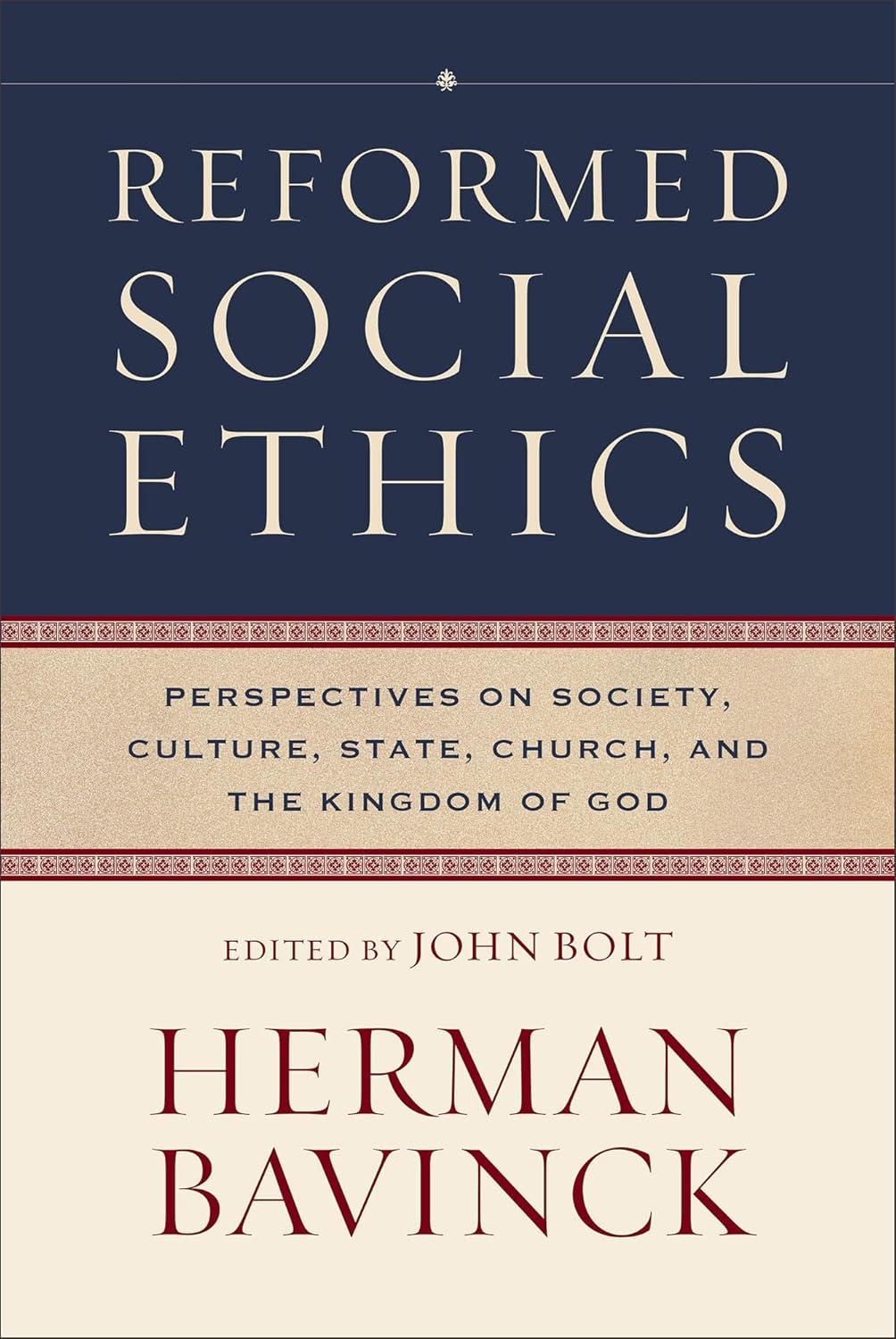
Overview of Reformed Social Ethics
This volume, titled Reformed Social Ethics: Perspectives on Society, Culture, State, Church, and the Kingdom of God, serves as a companion to Bavinck’s broader work on reformed ethics. In translating his writings for modern readers, John Bolt and his colleagues discovered that the portion on social ethics remained unfinished. While the opening section appears in a separate volume, the remaining sections were only outlined by Bavinck. Relying on his extensive knowledge of Bavinck’s thought, Bolt reconstructed these missing parts by drawing on the full range of Bavinck’s writings. The result is a clear summary of Bavinck’s views on key matters, including society, art, scholarship, education, the state, the church, humanity, and the kingdom of God.
Though formulated during an era very different from our own, Bavinck’s ideas continue to illuminate the enduring principles of Christian moral reasoning.
Bavinck’s Social Context
Bavinck developed his social ethics against the backdrop of late 19th- and early 20th-century European industrialization and urbanization. His time was marked by rapid social change, displacement, and the rise of reform movements that sought to address economic and political inequities through ideologies such as socialism and the social gospel.
He observed the emergence of various social reform groups that attempted to force a particular moral vision on society—often one that stood at odds with Christian teachings. Socialists and Christian social reformers alike challenged the status quo in ways that Bavinck found increasingly problematic. Deeply influenced by earlier critiques of materialism, he saw no option but to engage with politics as inseparable from religious conviction. His own political involvement in parliament reflected a commitment to resisting secularization and revolutionary excess, even as he remained wary of the potential for state abuse—a concern rooted in the long history of religious persecution in his homeland.
For Bavinck, the misuse of state power underscored the need for the church to exert its influence indirectly, relying on the transformative power of the gospel rather than on coercive measures.
Separating Church and State
Bavinck was uncompromising when it came to the purpose of the gospel, which he saw primarily as a call to salvation. However, he also maintained that living in accordance with Christian principles naturally involves striving for the common good. According to him, the gospel’s mission was not to drive aggressive social reform, but rather to foster moral renewal through the personal transformation of believers.
He underscored that, although Jesus acknowledged existing social conditions without attempting immediate change, the gospel nonetheless plants the seeds for gradual reformation. This reformation was to occur not by brute force, but through the subtle yet profound influence of renewed hearts over time.
Bavinck was cautious about the use of governmental power in moral matters. He warned against employing the state’s coercive authority to defend the church, insisting instead that the church’s role was to promote change through spiritual, not material, means. True moral virtue, he argued, emerges from an inner transformation rather than external imposition.
On Tolerating Inequality
Bavinck was not oblivious to the social ills of his era; he recognized the evils of racism, classism, and economic exploitation. Yet he believed that earthly inequalities were woven into the fabric of creation and reflected divine will. In his view, while the gospel profoundly reorders human relationships, it does not erase all differences and disparities present in society.
This perspective led him to contend that certain social distinctions—such as differences between rich and poor or between slave and free—were acknowledged even among early Christians. Redemption, he believed, reorders these relationships rather than eliminating them entirely. However, his approach sometimes blurred the line between divinely ordained differences and those exacerbated by sin.
Ultimately, Bavinck’s work invites Christians to develop a social ethic that is both deeply rooted in biblical truth and alert to the reality of sin. His thought reminds us that, in seeking to avoid the pitfalls of overreach in either direction, it is crucial to acknowledge and address the complexities of social inequality.
The enduring value of Bavinck’s social ethics lies not only in its historical context but in its continued relevance for how Christians today might thoughtfully approach issues of power, inequality, and social change.

Rockin’ the faith, one verse at a time!
Growing up, the Bible’s stories deeply impacted me. Now, with over 15 years of preaching experience, I blend timeless teachings with modern technology, making them relevant for today’s world.
Bible Hub Verse is my platform to share historical insights and thought-provoking articles, exploring both familiar and uncommon Christian topics. My passion is building a welcoming online space for everyone to learn, grow in their faith, and discover the Bible’s enduring message.
Join the journey!
God bless you.

 By
By